Rolex Explorer II Restoration: Restoring the Case and Bezel
A Rolex Explorer II can show visible signs of prolonged wear, particularly on the surfaces of its case and bezel.
This case study documents a Rolex Explorer II restoration carried out at Pendulum Laboratorio. The before-and-after photographs provide a direct comparison of the watch's condition, highlighting the restoration of the case surfaces and the improved legibility of the engraved 24-hour bezel.
Although the work focuses on highly visible exterior components, restoring a watch of this kind requires careful consideration of case geometry, surface finishes and the characteristics of the bezel engravings.
The photographs do not, however, establish whether any work was performed on the movement or other internal components. For this reason, this case study focuses exclusively on the restoration results documented in the images.
The case
Rolex Explorer II: Condition Before Restoration
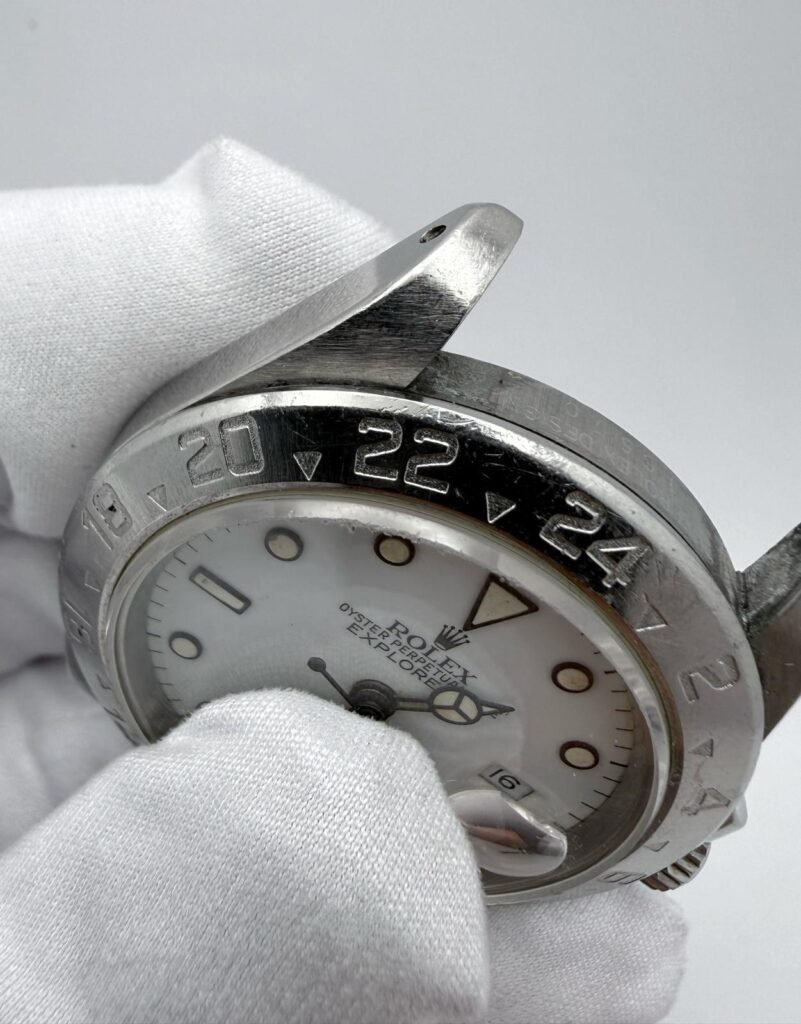
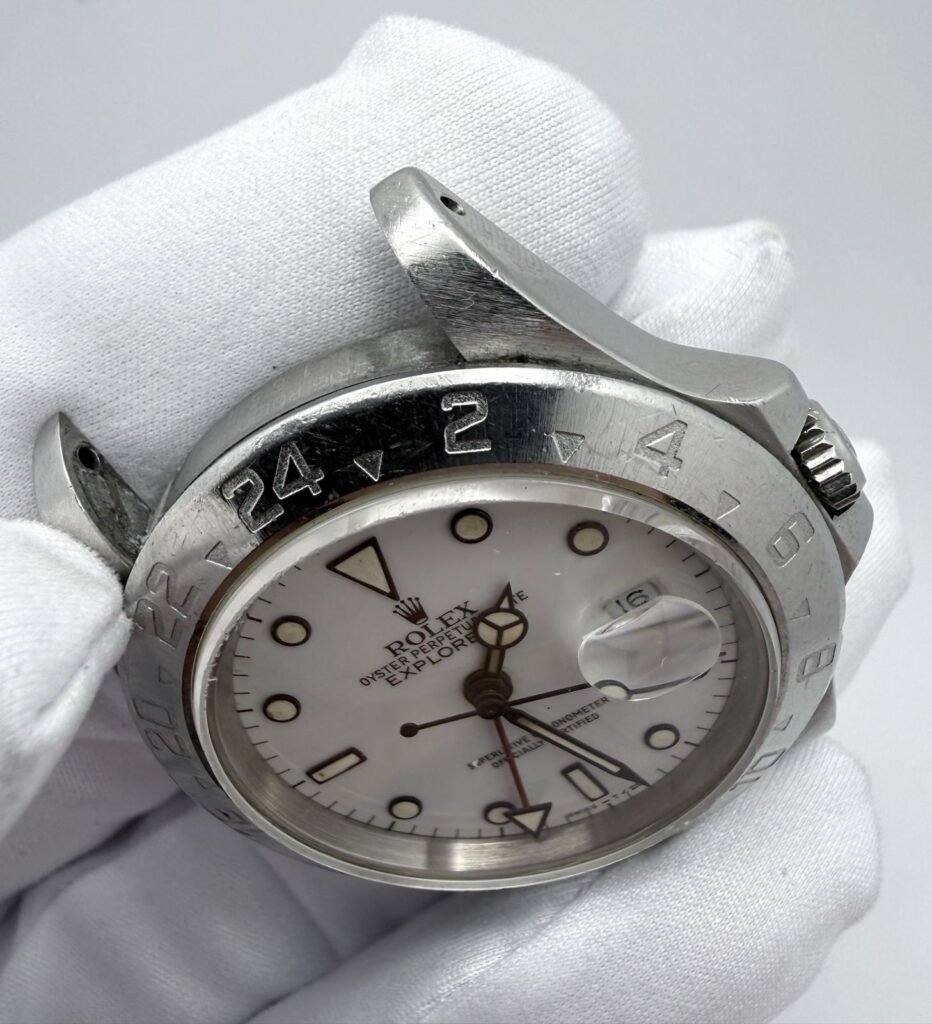
The initial photographs reveal extensive signs of wear across the watch case.
Numerous scratches and abrasions are visible on the case surfaces and lugs. The bezel also shows considerable wear, with the numerals and markings of its 24-hour scale appearing less legible than in the photographs taken after restoration.
The bezel itself also shows a clear difference between its original condition and its appearance following the restoration work.
These details illustrate why restoring a watch that has experienced years of regular use can involve considerably more than a straightforward polishing operation.
Before refinishing a watch case, it is essential to consider the shape of the lugs, the planes of the case surfaces, the edges and the different finishes applied to each component.
Rolex Case Restoration: Refinishing Surfaces While Preserving Geometry
A watch case is not a single, uniform surface.
In the photographed Rolex Explorer II, the case incorporates different finishes, including transitions between polished and brushed areas.
Following restoration, these distinctions are once again clearly visible.
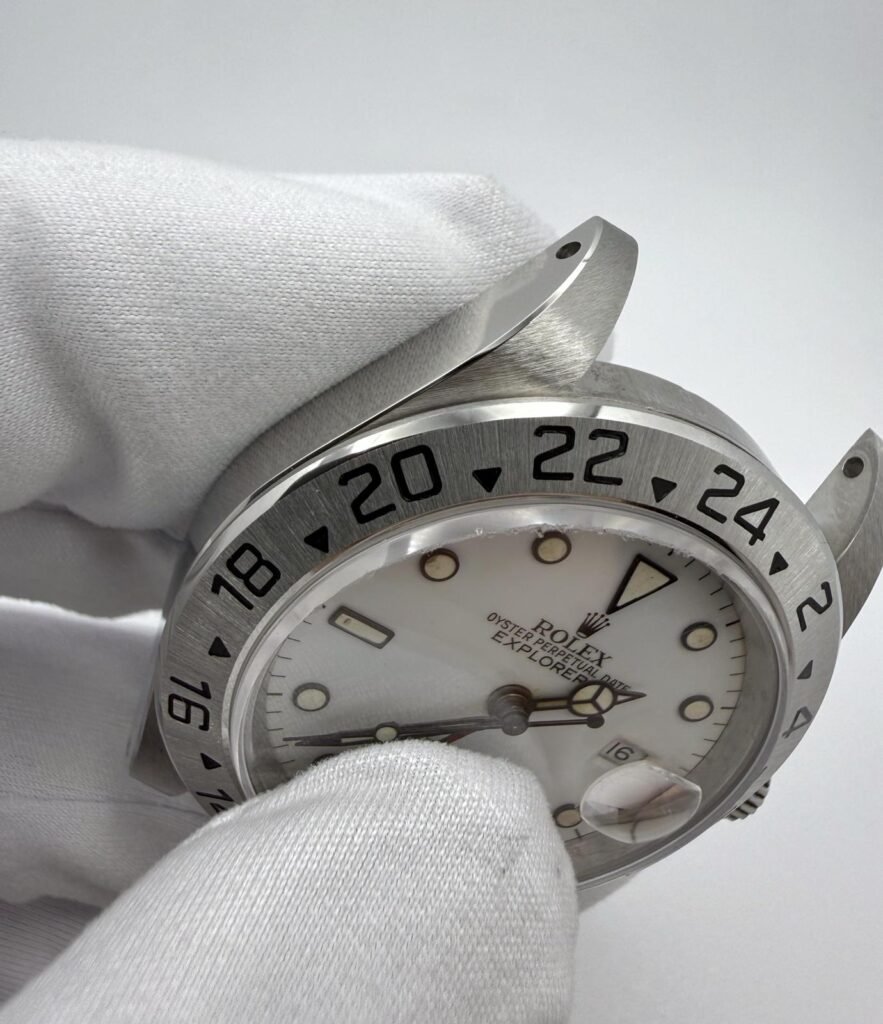
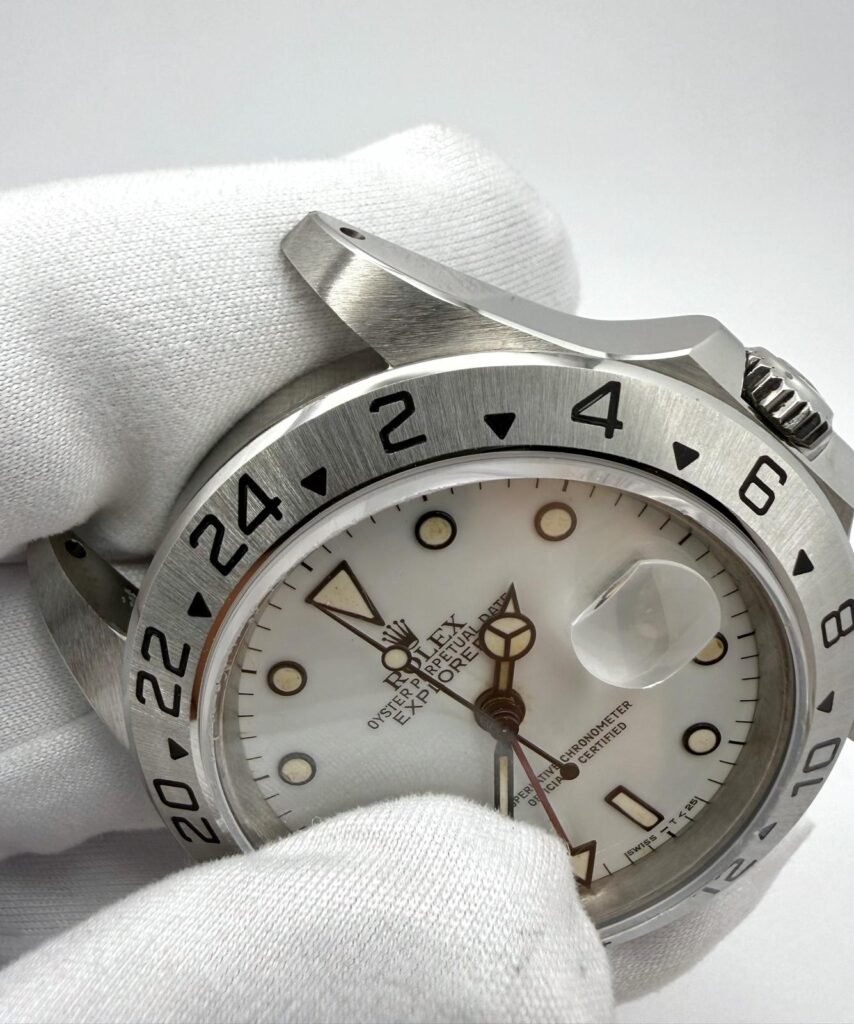
The lugs display more defined profiles compared with the initial photographs, while the case surfaces show a consistent finish that follows the overall geometry of the component.
This comparison helps illustrate an important distinction between simply polishing a watch case and restoring its surfaces through controlled refinishing.
Excessive or indiscriminate polishing can alter the edges, contours and original proportions of a case.
In aesthetic watch restoration, surface finishing cannot be considered independently of the geometry that defines the component.
The Restoration Process
Rolex Explorer II Bezel Restoration: Before and After
The bezel is one of the components that most clearly demonstrates the difference between the initial and final photographs.
Before restoration, several numerals on the 24-hour graduated scale appear worn and difficult to read.
In the subsequent photographs, the scale is noticeably more legible, and the markings display greater visual consistency.
The bezel surface also looks different. The refinished surface gives the component a more uniform overall appearance.
Restoring a bezel of this kind requires consideration of three interconnected elements: geometry, surface finish and engravings.
Simply making the numerals visible again is not sufficient if the bezel profile or surrounding finish is inconsistent with the component's design.
Restoring the Legibility of the Bezel Engravings
The photographs also document the improved legibility of the numerals and markings on the bezel.
In the images taken before restoration, some of these markings appear worn and poorly defined.
Following the work, both the numerals and the scale markings are easier to distinguish.
The finished bezel displays a clearer 24-hour scale and greater uniformity across its markings.
This is particularly important when working on components featuring engraved numerals and scales, as any refinishing must take into account the positioning and proportions of the existing details.
Rolex Explorer II Restoration: Before and After Comparison
The photographic comparison provides a clear illustration of the visible changes achieved during the restoration.
Before Restoration
The watch case displays numerous scratches and abrasions. Its surfaces appear uneven, and the definition of certain edges and profiles is less apparent.
The bezel shows visible wear, with reduced legibility across parts of the 24-hour scale.
After Restoration
The case surfaces appear more uniform, and the contrast between the different finishes is once again clearly distinguishable.
The lug profiles look more defined, while the case as a whole presents a consistent surface finish.
The bezel also displays improved legibility, with numerals and markings that are significantly clearer than in the initial photographs.
This before-and-after comparison does more than demonstrate an aesthetic improvement. It allows the viewer to examine which visible characteristics of the original components have been recovered through the restoration process.
Rolex Explorer II Caseback Restoration
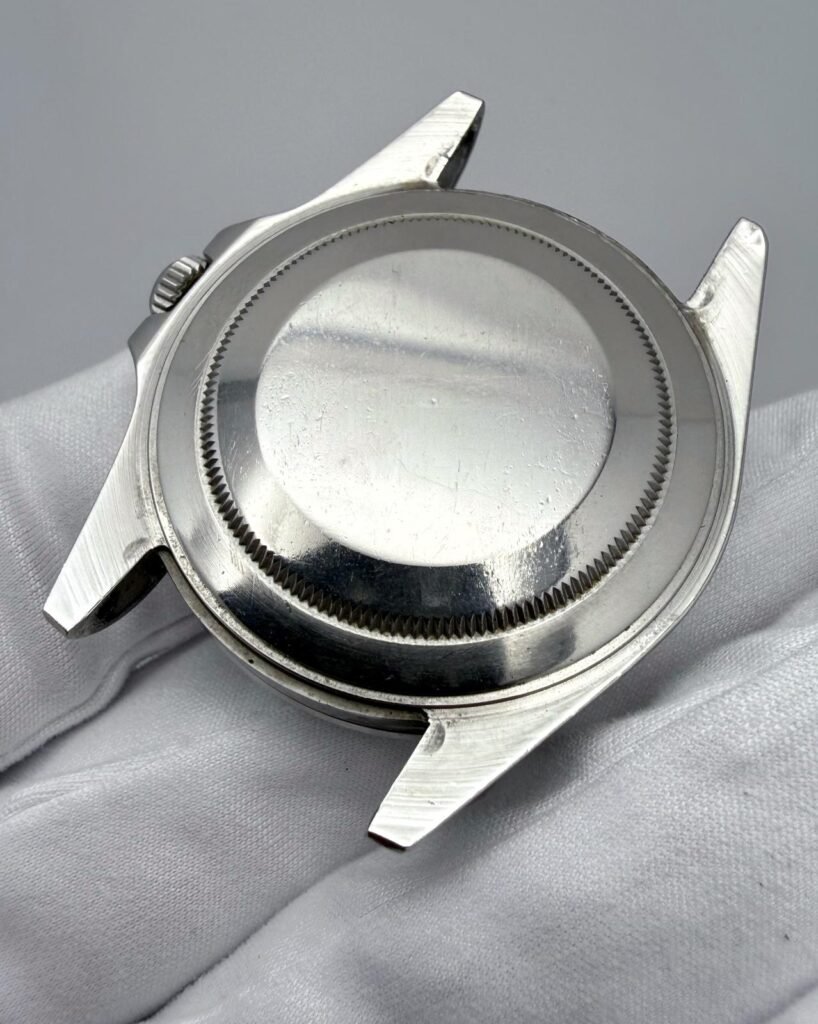
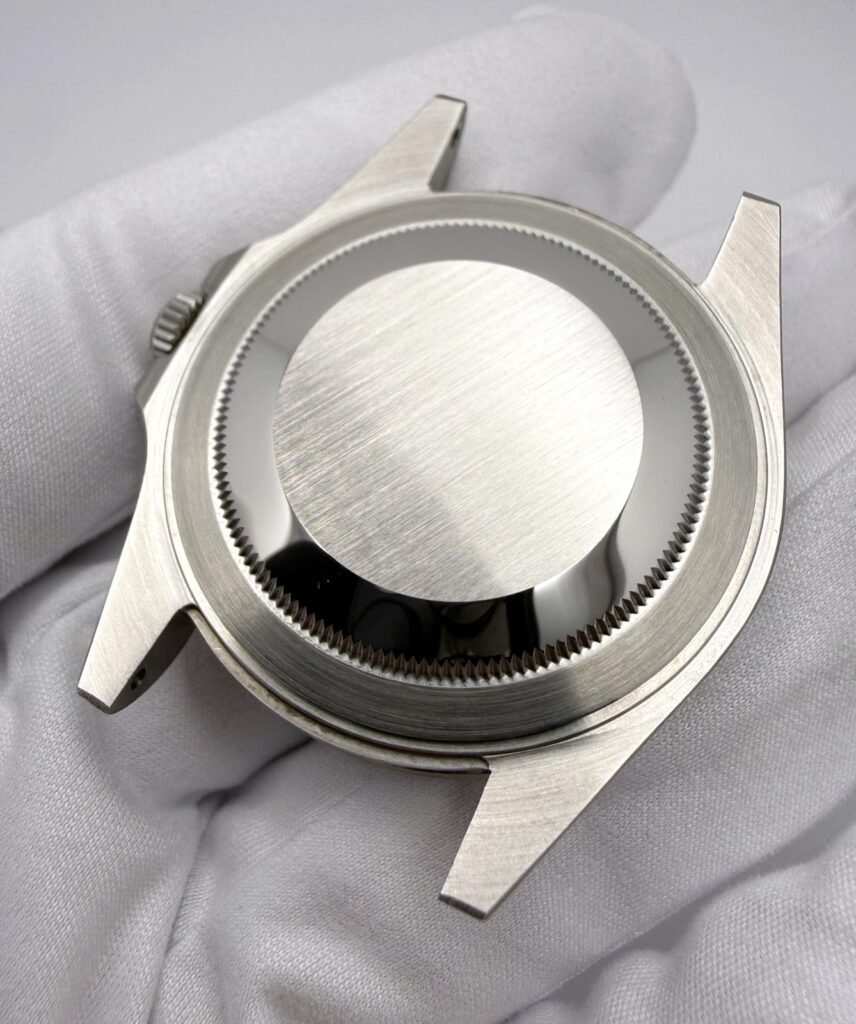
The photographs of the rear of the watch reveal another aspect of the restoration.
Initially, the caseback displays numerous scratches and abrasions across its surface.
In the photographs taken after restoration, the surface appears refinished, with a more uniform appearance and greater visual consistency.
Here too, the results should be assessed in relation to the geometry of both the case and the caseback.
Restoring a surface is not simply a matter of removing scratches. It also requires consideration of the component's shape and the characteristics of its finish.
Why Before-and-After Photographs Matter in Watch Restoration
The results of cosmetic watch restoration can be difficult to communicate through words alone.
Photographs provide a way to compare several important characteristics directly:
The initial condition of the watch case
The distribution and extent of scratches
The appearance of the case surfaces
The definition of the lugs
The condition of the bezel
The legibility of the engraved numerals and markings
The finish of the caseback
The final appearance of the restored components
For this reason, Pendulum Laboratorio documents restoration work through photographs of different stages whenever such images are available.
In the case of this Rolex Explorer II, the before-and-after comparison is particularly useful for examining the refinishing of the exterior surfaces and the improved legibility of the 24-hour bezel.
Watch Restoration vs. Component Replacement
When a bezel has worn numerals or a case displays extensive scratches, replacing the affected component may seem like the most immediate solution.
However, an existing original component can be assessed for restoration potential before replacement is considered.
In the documented Rolex Explorer II restoration, the work was carried out on the existing components, improving the appearance of the case surfaces and the legibility of the bezel.
Whether a component can be successfully restored depends on its condition, construction and individual characteristics.
Not every component can be treated in the same way, and not all forms of damage can be corrected.
Why the Relationship Between Geometry and Surface Finish Matters
This Rolex Explorer II case study demonstrates why watch restoration should always consider each component as a whole.
A watch case incorporates multiple surfaces, edges, lugs and finishes, all of which contribute to its overall appearance.
A bezel has its own geometry, surface characteristics and graduated scale.
Working on one of these elements without considering the others can produce an inconsistent result.
By contrast, the restoration documented in these photographs shows a finished watch in which the case and bezel display visually coordinated surface finishes.
Rolex Explorer II After Restoration: The Final Result
The final photographs show the Rolex Explorer II with more clearly defined case contours, uniform surface finishes and a bezel with legible numerals and markings.
Comparing these images with the watch's initial condition reveals the visible changes achieved through the restoration work.
It is precisely this type of photographic documentation that makes it possible to assess cosmetic watch restoration beyond an immediate visual impression. By examining the surfaces, geometry and recovered details, viewers can develop a clearer understanding of the results.
Nevertheless, every watch must be assessed individually before restoration work is undertaken. The condition of the case, its previous refinishing history and the state of its individual components can significantly influence whether a particular restoration is feasible.
When Should You Have Your Rolex Assessed for Restoration?
The Rolex Explorer II restoration documented in this article illustrates a principle that applies to many luxury watches: before replacing a component or refinishing a surface, it is worth assessing its condition and determining whether restoration is possible..
If you own a Rolex with visible wear on its case or bezel and would like to understand whether its original surfaces can be restored, you can request an individual assessment from Pendulum Laboratorio.
Popular Questions
It depends on the condition of the case and any previous refinishing work. Scratches and abrasions can be assessed alongside the geometry of the lugs, the case edges and the different surface finishes.
It depends on the condition of the component and its markings.
In the documented Rolex Explorer II restoration, the bezel numerals and markers appear more legible following the refinishing work.
Yes. A preliminary assessment allows the condition of the watch case and its individual components to be examined, helping determine which restoration procedures, if any, may be appropriate.
Contact
info@pendulumlaboratorio.com
+39 3477670913
Partita IVA 02365780507
 English
 Italian