Damaged Watch Bezel: Restore or Replace?
A scratched, deformed, or worn watch bezel often raises an important question: is it better to restore the original bezel or replace it?
The answer depends on the type of damage, the material, the component's geometry, and any previous work carried out on it.
When dealing with a vintage watch, the bezel's history must also be considered. An original component may retain distinctive characteristics associated with the watch model and its production period, which could be altered through replacement.
For this reason, examining the bezel carefully is an essential first step before deciding how to proceed.
The guide
Different Types of Watch Bezel Damage
Scratches, dents, deformation, and worn engravings are not all the same problem.
A bezel may show minor surface abrasions, while an impact may have altered its original profile. In other cases, the bezel's shape remains well preserved, but its numerals and markings have lost definition.
Common types of bezel damage include:
- Scratches and surface abrasions
- Dents
- Deformation
- Material loss
- Altered surface finishes
- Faded or poorly legible numerals
- Worn or damaged engravings
- Signs of previous restoration or refinishing
The nature of the damage determines which restoration or replacement options should be considered.
First Consideration: How Much Material Remains?
When a watch bezel is scratched, polishing may seem like the most straightforward solution.
However, removing a scratch involves removing a certain amount of material from the surface.
If the damage is superficial, a limited refinishing procedure may be sufficient.
If the scratch is deeper or affects a shaped area, attempting to eliminate it completely could alter the bezel's original profile.
Before proceeding, several factors need to be assessed:
- Location of the damage
- Extent of the affected area
- Amount of material remaining
- Original bezel geometry
- Evidence of previous polishing or refinishing
The key question is not simply whether a scratch can be removed, but how removing it would affect the original component.
Key factors to consider
Why Watch Bezel Geometry Matters
A watch bezel is more than a simple circular surface.
Its profile, thickness, edges, and transitions between surfaces contribute to the overall design of the watch and must be carefully considered during restoration.
Bezel Profile
The side profile should remain consistent with the bezel's original design and construction.
Bezel Edges
Excessive polishing or refinishing can soften the definition of the original edges.
Bezel Thickness
The amount of material remaining directly affects the restoration techniques that can be considered.
Relationship Between the Bezel and the Watch Case
The bezel must retain proportions that are consistent with the rest of the watch.
A heavily scratched bezel may still preserve enough of its original characteristics to make restoration possible. Conversely, a bezel that appears relatively well maintained may have undergone previous polishing or refinishing that has already altered its geometry.
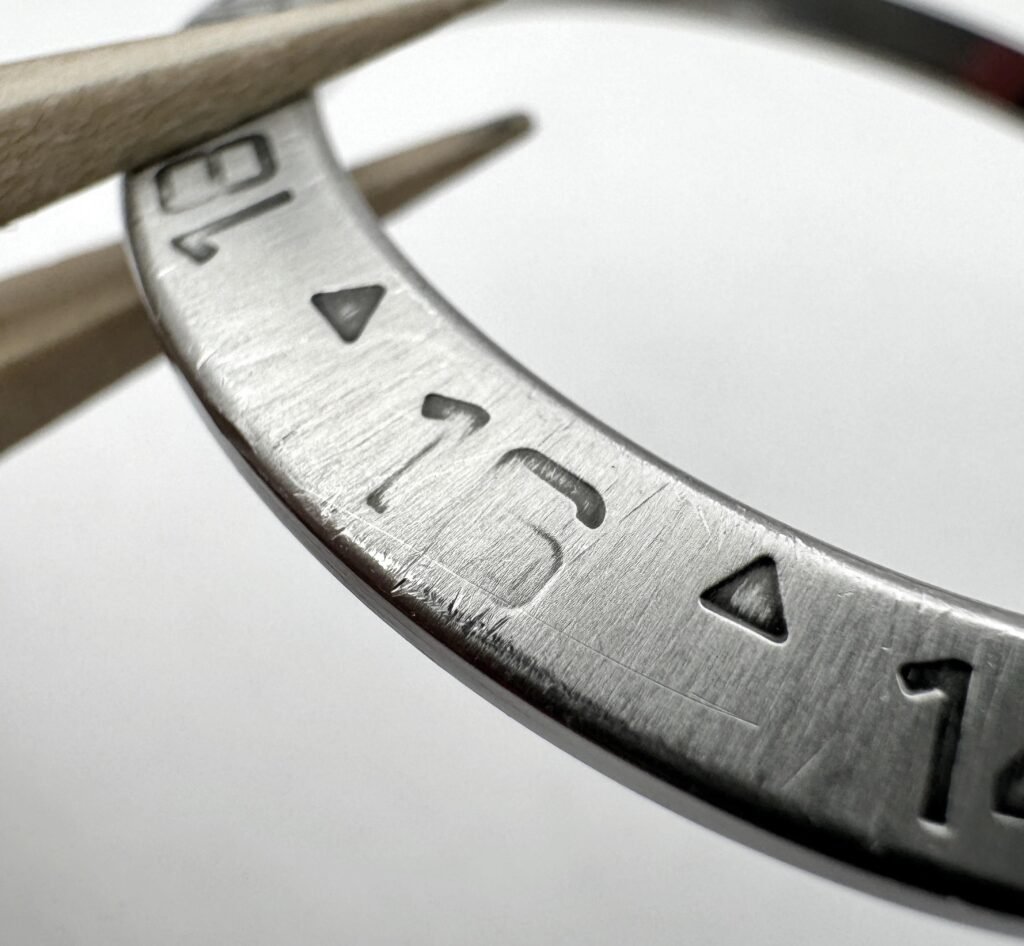
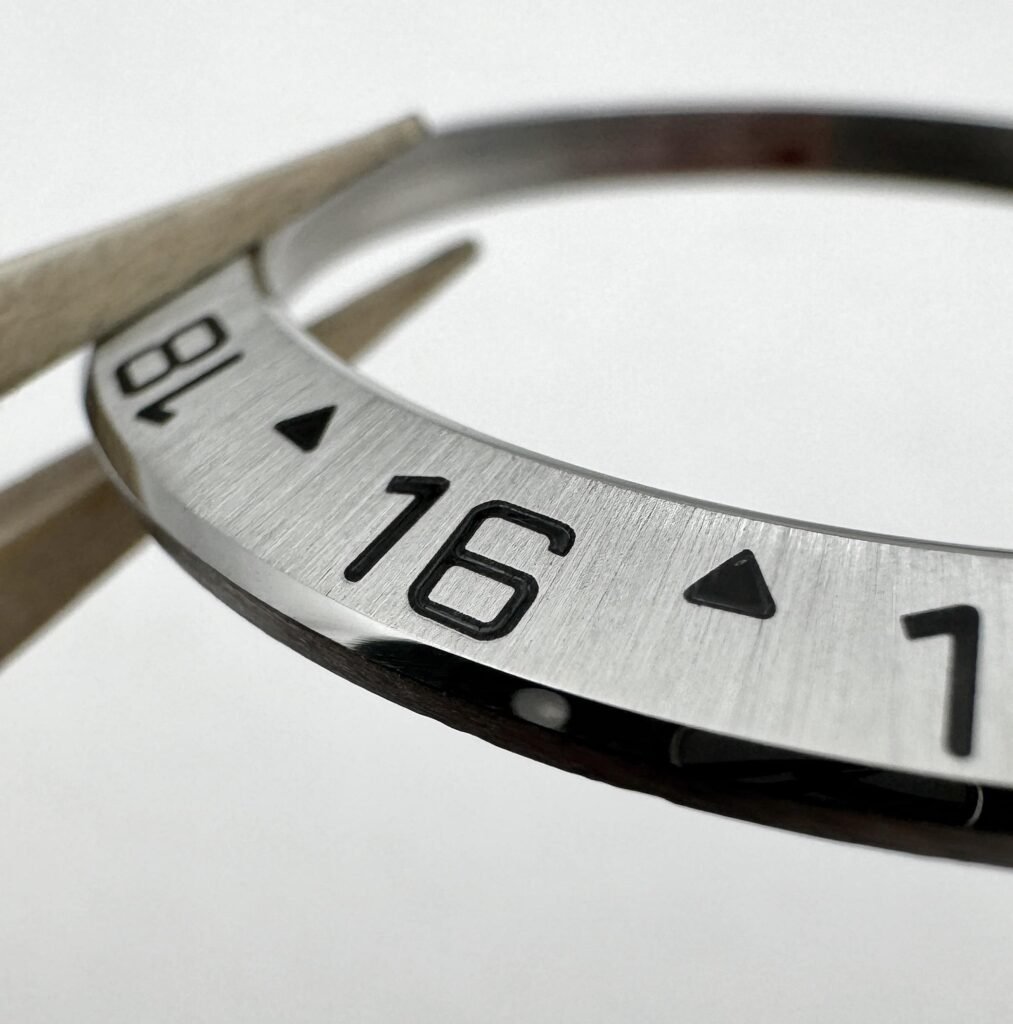
Worn Bezel Numerals and Engravings: What Can Be Restored?
Numerals, scales, indices, and lettering can gradually lose definition through regular wear and the passage of time.
Restoring these details requires a different assessment from that of a scratched surface.
Several elements must be examined:
- Which details remain legible
- How much of the original engraving is preserved
- Original numeral and font shapes
- Alignment and positioning
- Condition of the surrounding surface
When sufficient original references remain available, localized restoration of the markings may be considered.
Restoring a engraving can be used, where technically appropriate, to recreate numerals, indices, scales, or lettering.
However, the feasibility of this process depends on the bezel's condition and the availability of reliable references needed to reproduce the original details accurately.
How Bezel Materials Affect Restoration Options
A stainless steel watch bezel has different characteristics from one made of gold, platinum, or titanium.
The material influences the restoration techniques that can be applied, the surface finishes, and the possibilities for recovering the component's original appearance.
Before choosing between bezel restoration and replacement, it is important to identify:
- Material
- Surface finish
- Component construction
- Existing engravings
- Any inserts
- Overall surface condition
The photographs in the carousel illustrate these differences: yellow gold, white gold and rose gold bezels may require different assessments, even when the visible damage appears similar.
Is Replacing a Watch Bezel Always the Easiest Solution?
When a bezel has extensive scratches or deformation, replacement may initially seem like the quickest option.
Before choosing a replacement bezel, however, several characteristics should be verified:
- Availability of the replacement component
- Compatibility with the specific watch model
- Production period
- Material
- Surface finishes
- Original marking characteristics
- Possibility of restoring the existing bezel
These considerations are particularly important when working with vintage watches.
An original bezel, even when visibly worn, may retain characteristics that differ from those of a replacement component manufactured at a later date.
A Vintage Watch Bezel Does Not Necessarily Need to Look New
Signs of wear can tell part of a watch's history.
Scratches, changes in colour, worn markings, and other signs of ageing may be considered characteristics worth preserving by the owner.
Before any restoration work begins, it is therefore important to establish the intended objective:
Is the goal to recover a specific detail, reduce visible damage, or preserve the bezel in its current condition?
Each approach may require a very different intervention.
For a vintage watch, preserving an aged surface can be just as deliberate a decision as restoring a damaged profile or recovering a worn marking.
What If the Watch Bezel Has Already Been Polished or Restored?
A bezel that has previously undergone polishing, refinishing, or other restoration work requires particular attention.
Previous interventions may have altered:
- Thickness
- Edges
- Profile
- Surface finishes
- Engravings
In these cases, further refinishing could remove additional material from a component that may already have lost part of its original geometry.
Whenever possible, understanding the bezel's restoration history is therefore important before deciding how to proceed.
Restoration Example: A Watch Bezel with Faded Numerals
Consider a watch bezel with a numerical scale that remains only partially visible.
At first glance, replacing the entire bezel might seem necessary.
However, a more detailed inspection could reveal that:
- The original profile is still preserved
- Surface abrasions are localized
- Some numerals remain legible
- The bezel geometry shows no significant deformation
- Sufficient material remains for a targeted intervention
Under these conditions, restoring the original bezel may be worth considering before searching for a replacement.
The objective would be to limit the restoration work to the affected areas, avoiding unnecessary modifications to the rest of the component.
A Different Scenario: Previously Altered Bezel Profiles and Edges
Now consider a bezel that has undergone multiple polishing procedures.
Its edges may have lost definition, its thickness may have been reduced, and its original shape may have been altered.
In this situation, removing additional surface marks could require further material removal.
The question therefore becomes:
How much of the original bezel geometry can still be recovered without causing further alterations to the component?
The answer depends on the bezel's actual condition.
Watch Bezel Restoration vs Replacement: Two Different Approaches
Restoration focuses on working with the existing component.
Replacement, on the other hand, involves installing another component in its place.
The two approaches should therefore be compared by considering the following factors:
Bezel Restoration | Bezel Replacement |
Preserves the existing component | Introduces another component |
Takes the component's history into account | Requires a compatible replacement |
Can target specific damaged areas | Replaces the entire bezel |
Depends on the amount of material remaining | Depends on replacement part availability |
May preserve original characteristics | May alter the watch's original configuration |
There is no single solution that applies to every damaged watch bezel.
The appropriate choice depends on the component, the watch itself, and the intended purpose of the intervention.
When Is Watch Bezel Restoration Worth Considering?
Restoring a watch bezel may be a suitable option when:
- The original geometry is still preserved
- Sufficient material remains for restoration work
- The damage is localized or technically manageable
- Worn markings can be reconstructed
- The original component has characteristics worth preserving
- The proposed restoration techniques are compatible with its existing condition
In these situations, a professional bezel assessment may be worthwhile before searching for a replacement component.
When Might Watch Bezel Replacement Be Preferable?
Replacing a damaged watch bezel may be considered when:
- Damage affects a substantial portion of the component
- The original geometry has been compromised
- Insufficient material remains for suitable restoration work
- Previous interventions have significantly altered the bezel profile
- A consistent and appropriate surface finish cannot be achieved
- A replacement bezel compatible with the watch model and its configuration is available
Even in these circumstances, the decision should be made in relation to the overall condition and characteristics of the watch.
How to Photograph a Damaged Watch Bezel for an Initial Assessment
If you would like to have a damaged watch bezel assessed, a few carefully taken photographs can provide useful preliminary information.
Full Watch View
A photograph of the entire watch helps show the relationship between the bezel, case, and dial.
Front View of the Bezel
A clear frontal image helps identify numerals, scales, scratches, and other markings.
Side Profile View
A side photograph can reveal the bezel's profile, thickness, and possible deformation.
Close-Up of the Damage
A detailed photograph of the affected area helps distinguish between surface abrasions, dents, and material loss.
Photographs cannot replace a direct physical inspection of the component, but they can provide valuable information for an initial evaluation.
Should You Have Your Watch Bezel Assessed Before Replacing It?
If the bezel is original, belongs to a vintage watch, or features details that are difficult to source, a professional assessment may be worthwhile.
A detailed evaluation can help determine whether it is possible to restore:
- The surface
- The original profile
- The finishes
- The numerals
- The engravings
- Other distinctive component details
Only after this assessment does it become possible to make an informed comparison between restoration and the availability of a suitable replacement.
Have a Damaged Watch Bezel?
If your watch bezel has scratches, deformation, worn markings, or altered finishes, you can begin by taking a few clear photographs of the component and the watch.
Pendulum Laboratorio can examine the bezel's condition and evaluate which restoration options may be technically compatible with the original component.
Popular Questions
No. Scratches do not automatically mean that a watch bezel needs replacing. Their depth and extent, the amount of material remaining, the original geometry, and the overall condition of the component must all be considered.
When the component's condition allows it, restoring worn numerals and markings may be possible. The feasibility of the intervention depends on the condition of the existing engravings and the availability of suitable references.
Yes. Restoration techniques involving material removal can alter the bezel's profile, edges, and thickness. For this reason, the original geometry must be carefully assessed before any work is carried out.

Contact
info@pendulumlaboratorio.com
+39 3477670913
Partita IVA 02365780507
 English
 Italian