Inherited Watch Restoration: What to Check Before Having Your Watch Restored
Before restoring an inherited watch, it is important to document its condition and gather as much information as possible about its history.
The history of a watch passed down through generations is not always known. Original documentation may be missing, the date of its last service may be unclear, or it may be difficult to determine whether certain components have been replaced over the years.
This is whythe first step is to carefully examine the watch and only then decide whether restoration is necessary and which work should be carried out.
The guide
Check the Watch Movement Before Attempting to Run It
If an inherited watch has not been used for a long time, avoid repeatedly winding the crown simply to see whether it starts running again.
The movement may only require routine servicing, but it could also show signs of wear or contain components that need closer inspection.
Even if the hands begin moving again, this alone does not mean the watch is ready for regular use.
If the service history is unknown, having the movement inspected before wearing the watch regularly is advisable.
Mechanical watch servicing focuses on the internal operation of the timepiece and is separate from any cosmetic restoration work.
What to Look for When You Inherit a Watch
Before taking an inherited watch to a professional restoration workshop, look for any documents or objects that could help establish its history.
Useful items may include:
- Original purchase documents
- Certificates of authenticity
- Warranty booklets and manuals
- Previous servicing receipts
- Invoices
- Original watch box
- Straps or bracelets stored separately
- Photographs of the previous owner wearing the watch
Even an old servicing receipt may contain valuable information about previous maintenance or the replacement of specific components.
Photographs can be equally useful. An image taken many years ago may reveal the original dial configuration, bracelet or details of the watch case that have since changed.
There is no need to reconstruct the watch's entire history. Even a small amount of information can help a watch restoration specialist better understand its current condition.
Key factors to consider
How to Identify an Inherited Watch
Before considering watch restoration, gather any identifying information that is visible without opening the case.
Look for:
- Watch brand
- Model name, if indicated
- Reference number
- Serial number
- Numbers engraved on the case back
- Hallmarks or markings on the case
- Reference numbers or markings on the clasp or bracelet
If you find an inscription or number, photograph it before attempting to clean the surface.
The brand alone is not always enough to identify a particular watch model accurately. The reference number, production period, case configuration and existing components may provide additional information.
Do not open the watch case simply to search for information that is not visible externally. If identification requires examining markings inside the case, this should be carried out by a qualified watchmaking professional.
Watch Case Restoration: What to Check Before Polishing
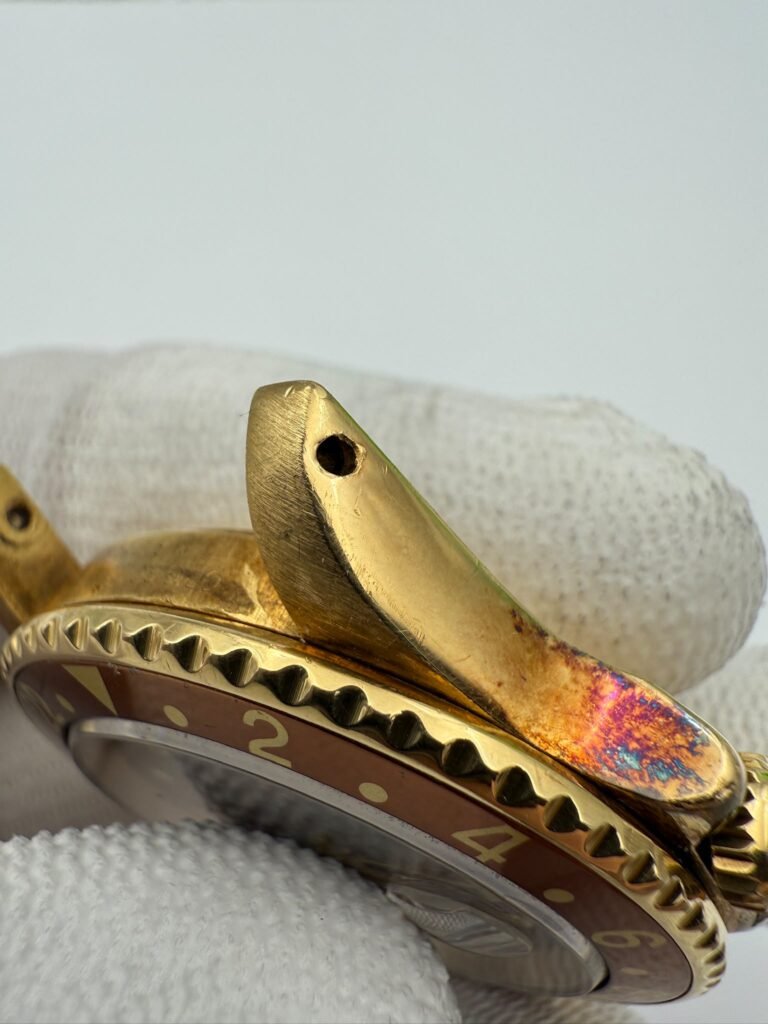
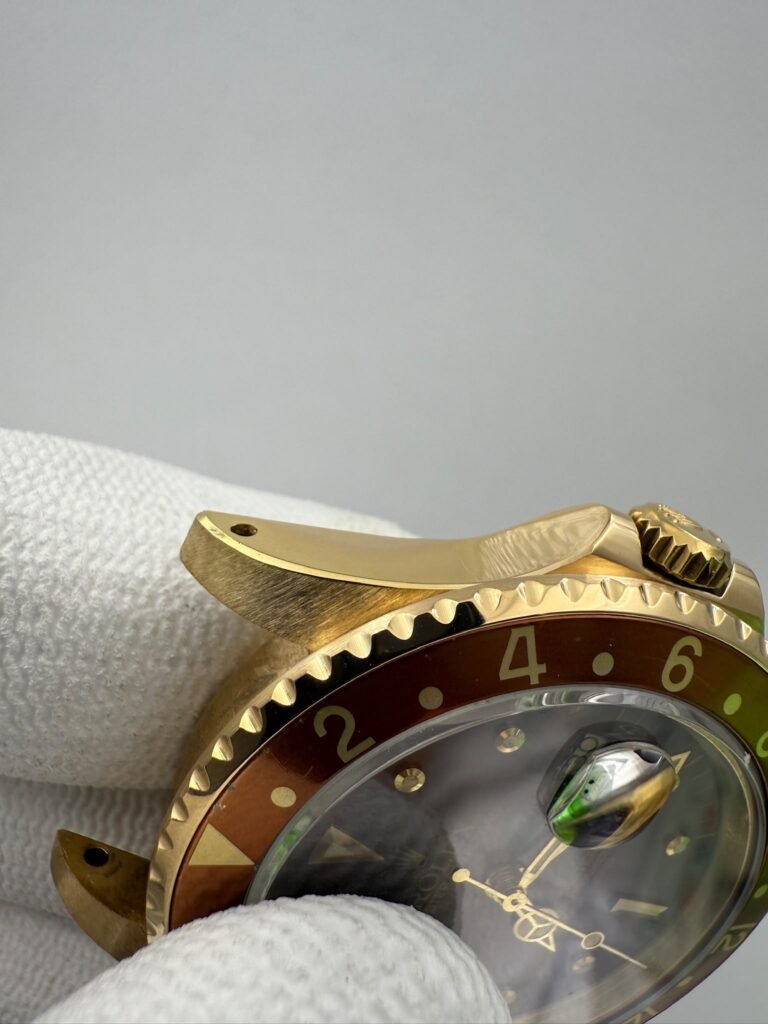
Scratches and signs of wear are often the first things noticed on an inherited watch case.
Before considering watch case polishing or refinishing, examine the following details:
- Shape of the lugs
- Case edges
- Existing bevels or chamfers
- Polished surfaces
- Brushed or satin-finished surfaces
- Differences between adjacent surfaces
- Evidence of previous polishing or refinishing
Polishing removes a small amount of material from the surface. If a watch case has already been polished several times, further polishing may alter its shape and original geometry.
For this reason, a scratch should never be assessed in isolation.
The first step is to evaluate the overall condition of the case and determine whether its original shapes and finishing details are still recognisable.
At Pendulum Laboratorio, aesthetic watch case restoration is a dedicated service. The condition, finish and characteristics of each case are carefully assessed before deciding which restoration techniques are appropriate.
Watch Dial Restoration: What to Examine
A watch dial requires a different approach from the case.
When examining the dial of an inherited or vintage watch, pay attention to:
- Surface colour
- Condition of printed text and markings
- Hour markers
- Hands
- Visible stains
- Discolouration
- Signs of moisture
- Evidence of previous restoration work
Photograph the dial before attempting any cleaning.
An unsuitable cleaning procedure can damage the surface or printed details, making it more difficult to determine which characteristics were present before the intervention.
A change in dial colour does not necessarily mean restoration is required. It is important to understand whether the change is the result of natural ageing, exposure to external factors or previous restoration work.
Watch Dial Patina, Stains and Oxidation: Understanding the Differences
The colour of a vintage watch dial may change over time.
Uniform discolouration may have a different cause from an isolated stain, oxidation or moisture-related deterioration.
Before deciding whether dial restoration is necessary, consider:
- Extent of the alteration
- Uniformity of the colour
- Condition of printed markings
- Signs of moisture damage
- Evidence of previous restoration work
Not every visible sign of ageing needs to be removed.
Worn Watch Engravings: What to Avoid
Watch case backs, cases, bezels, bracelets and clasps may feature engraved numbers, inscriptions, logos or other markings.
Over time, these details can become less legible due to everyday wear or previous surface refinishing.
If anengraving appears worn, avoid attempting to deepen or redefine it using sharp tools or abrasive products.
Instead, carefully photograph any remaining visible details.
The shape, positioning and spacing of the characters can provide valuable information during a professional assessment.
If engraving restoration is required, the work must take into account the existing surface and the original characteristics of the lettering.
How to Tell Whether Watch Parts Have Been Replaced
A watch that has been worn for many years may have received replacement components during previous servicing.
These may include:
- Watch crystal
- Crown
- Dial
- Hands
- Bezel
- Case back
- Bracelet
- Movement components
The presence of replacement parts does not automatically indicate that previous servicing or restoration was inappropriate.
A component may have been replaced because it was worn, damaged or no longer suitable for the proper operation of the watch.
Before carrying out new restoration work, the priority is to identify which components are currently fitted and, where possible, establish their origin.
Old servicing receipts can be particularly valuable in this process.
Family photographs may also provide a useful point of comparison. If an image shows the watch many years earlier, it may help establish which components were already present at that time.
Does a Working Inherited Watch Still Need Servicing?
Yes, it may still be advisable.
The fact that a watch is running does not necessarily mean its movement is in good condition.
A mechanical watch can continue operating while gaining or losing time, stopping occasionally or experiencing winding problems.
If the watch has remained unused for several years, having it inspected before returning to regular wear is recommended.
Professional mechanical watch servicing makes it possible to assess the movement's condition and determine whether any components require attention.
Condensation or Moisture Inside a Watch: What Should You Do?
Condensation beneath the watch crystal should never be overlooked.
The same applies to dial stains that may be associated with water exposure or visible signs of oxidation.
If you notice these problems, avoid continuing to wear or operate the watch until it has been professionally inspected.
The water resistance of the case and the condition of any components potentially affected by moisture should be checked.
Watch water resistance testing is therefore a separate procedure from cosmetic restoration.
What Not to Do Before Having an Inherited Watch Assessed
Before bringing an inherited watch to a restoration workshop, avoid any action that could change the condition of its components.
In particular:
- Do not attempt to polish the watch case yourself.
- Do not clean the dial using household products.
- Do not try to restore worn engravings with improvised tools.
- Do not force the crown if the movement is stuck.
- Do not open the case without the appropriate tools.
- Do not replace components before documenting their condition.
Start by photographing the watch.
Then gather any available documentation.
This will allow a watch restoration specialist to assess the timepiece without its original condition having been altered.
Does an Inherited Watch Need a Complete Restoration?
Not necessarily.
An inherited watch may require a single procedure or several different types of restoration work.
Attention may be needed on the movement, case, dial, bracelet or an engraving.
In other cases, certain components may be best preserved in their current condition.
There is no reason to assume in advance that every inherited watch needs a complete restoration.
A professional assessment helps distinguish between components that require attention and those that can be preserved.
How much does inherited watch restoration cost?
There is no standard price for inherited watch restoration.
The cost depends on the condition of the individual timepiece and the specific work required.
A watch that only needs mechanical movement servicing will have different requirements from one that also needs case refinishing, dial restoration, bracelet work or engraving restoration.
Photographs can be useful for an initial assessment, but they do not always provide enough information to determine accurately which procedures are necessary.
For a reliable estimate, a direct examination of the watch is therefore preferable.
Should You Preserve or Restore the Original Appearance of an Inherited Watch?
Before beginning any restoration work, it is important to establish which characteristics of the watch should be preserved.
Some owners prefer to retain the marks and signs of wear accumulated over years of use.
Others may wish to address a damaged surface or a component that has been altered over time. These are different objectives and may require different approaches.
A watch case with minor scratches may be left in its current condition. A deformed component, on the other hand, may require restoration.
Similarly, a dial with uniform colour changes may be preserved as it is, while a dial affected by moisture damage may need a different assessment.
There is no single restoration procedure that should automatically be applied to every inherited watch.
When Should You Contact a Professional Watch Restoration Workshop?
A professional assessment can be valuable when the condition of the movement is unknown, when a watch has not been used for years, or when there are visible changes to the case, dial, bracelet or other components.
It is equally important before polishing, replacing components or carrying out any procedure that modifies an existing surface.
Bringing the watch to a professional workshop without first altering its condition allows specialists to assess it as it was originally received.
Pendulum Laboratorio specialises in the restoration and servicing of vintage,modern and luxury watches, offering dedicated services for mechanical movements, watch cases, dials, bracelets, engravings and water resistance testing.
Popular Questions
If the condition of the movement is unknown, avoid forcing the crown. A professional inspection can determine whether it is appropriate to restart the watch and whether mechanical servicing is necessary.
It depends on the type of alteration. Natural colour changes that develop over time are different from stains, oxidation or deterioration caused by moisture. Each situation should be assessed individually before deciding whether restoration is appropriate.
It is advisable to avoid household cleaning products and improvised procedures. Unsuitable cleaning techniques may damage printed markings, surface finishes and other delicate dial details.
The cost depends on the condition of the watch and the work required. The brand and age of a timepiece alone are not enough to determine the cost of restoration.
Contact
info@pendulumlaboratorio.com
+39 3477670913
Partita IVA 02365780507
 English
 Italian